
By Dženan Hamzić | October 2026
Some ideas take years to become reality.
In my case, it took approximately 14 years to turn an idea inspired by an Austrian price comparison website into a functioning platform for Bosnia and Herzegovina.
Today, Škrtica.ba brings together more than 550,000 products and 770,000 offers from hundreds of online retailers across the country.
Within just five days of its public announcement, the platform recorded more than 50,000 page views.
But one of the most surprising moments came before the platform was even publicly available.
While testing an early demo, I discovered that a single day’s snapshot of indexed products contained more than 6 million KM in aggregated price differences between retailer offers.
That was the moment I began to realize just how valuable transparent price information could be.
Behind Škrtica lies a combination of software engineering, machine learning, custom AI models, Transformer-based architectures, and an idea that started during my student years in Vienna.
But the story of Škrtica is not only about technology.
It is also about a long-standing idea, an unusual name inspired by my daughter, and my desire to build something useful for people in Bosnia and Herzegovina.
This is the story of how Škrtica came to life.
Where It All Started: Geizhals.at and My Student Years in Vienna
Around 14 years ago, while studying Computer Science at TU Wien (Vienna University of Technology), I frequently used the Austrian price comparison platform Geizhals.at.
Like many computer science students and technology enthusiasts, I was interested in computer hardware.
Whenever I needed a processor, graphics card, memory, or another computer component, Geizhals was one of the first websites I visited.
Instead of checking individual online stores, I could compare offers from different retailers and find competitive prices in one place.
It was simple, practical, and genuinely useful.
At approximately the same time, during my bachelor’s studies at TU Wien, I worked as a software architect on a hotel-offer platform that supplied hotel listings to Trivago.com.
That experience introduced me to the technical challenges behind large digital comparison and aggregation platforms.
Working with hotel offers, different data sources, and complex software systems helped me understand how information from multiple providers could be transformed into a simple and useful experience for consumers.
These experiences eventually led me to a question:
Why shouldn’t consumers in Bosnia and Herzegovina have a similarly convenient way to compare prices across online stores?
The idea was born.
However, professional responsibilities, academic work, and other priorities took over.
Over the following years, I continued my career in software engineering, artificial intelligence, and scientific research.
The concept of a Bosnian price comparison platform remained in the back of my mind.
It would take approximately 14 years before I finally decided to turn it into reality.
Why the Name Škrtica?
The name has two inspirations: one technological and one very personal.
The original concept was inspired by Geizhals.at.
In German, Geizhals roughly translates to a miser, or someone particularly careful with money.
I liked the playful connection between the name and the idea of saving money.
But the final name, Škrtica, has an even more personal meaning.
I have a young daughter whom I affectionately call Škrtica whenever she doesn’t want to give me something or share something with me.
It became a little family joke.
When I eventually started thinking seriously about launching the platform, the name felt like a natural choice.
It was short, memorable, easy to pronounce, and directly connected to the idea of being careful with money.
More importantly, it had a personal story behind it.
After having the concept in mind for approximately 14 years, I finally found an available domain in 2026 that I really liked:
Škrtica.ba.
That was the moment when an old idea started becoming a real project.
What Is Škrtica.ba?
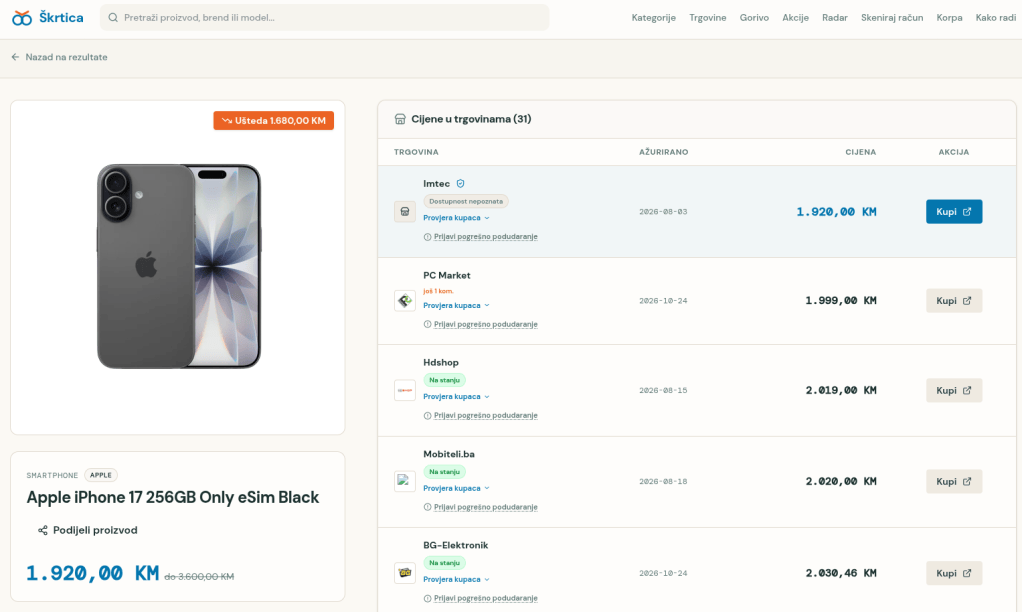
Škrtica.ba is a free price comparison and smart shopping platform developed for consumers in Bosnia and Herzegovina.
It collects, processes, and organizes product offers from hundreds of online retailers, allowing users to compare prices, track products, and discover better deals in one place.
The concept is straightforward:
Search once. Compare prices. Shop smarter.
Consumers can search for products, explore available offers, compare prices from different retailers, and visit the selected online store to complete a purchase.
Škrtica does not sell products directly.
Instead, it helps consumers discover offers from existing retailers and make more informed purchasing decisions.
However, comparing current prices is only one part of the platform.
From the beginning, I wanted Škrtica to evolve beyond a traditional price comparison website into a more intelligent shopping assistant.
A platform that does not only answer:
Where can I buy this product at the lowest price?
But also:
Is this a good time to buy? Should I wait? Can the platform notify me when a better offer becomes available?
These questions shaped several of Škrtica’s most interesting features.
Beyond Price Comparison: Smart Shopping Features
One of my main objectives has been to make Škrtica useful not only when someone is ready to buy a product, but throughout the entire purchasing decision process.
Consumers often know what they want to buy, but they do not necessarily know when or where to purchase it.
Sometimes the best decision is to wait for a price reduction.
In other cases, the current price may already represent an attractive opportunity.
To address these situations, Škrtica includes several features designed to make shopping more convenient, transparent, and informed.
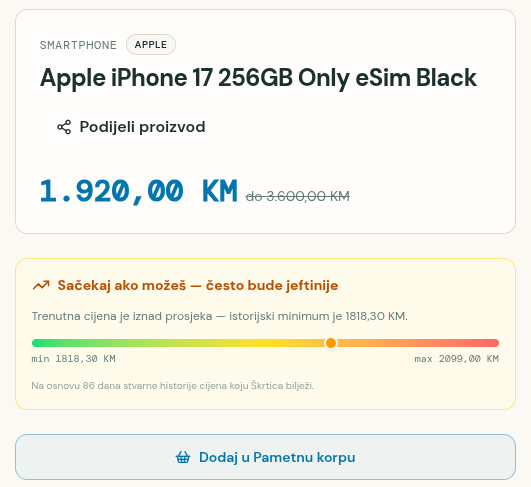
1. Buy Now or Wait? — Data-Driven Shopping Recommendations
One of the features I find particularly useful is Škrtica’s ability to help consumers answer a simple but important question:
Should I buy this product now, or would it be better to wait?
Finding the lowest available price is useful.
Understanding whether that price is attractive compared with recent historical prices is even more valuable.
Škrtica tracks product prices over time and uses the collected historical information to provide contextual purchasing recommendations.
For example, the platform may display:
“Excellent Price — Buy Now”
This recommendation indicates that the current price is at or near the lowest price observed during the available monitoring period.
The interface also visualizes the product’s historical price range, making it easier to understand where the current offer stands.
In one example, Škrtica analyzed 47 days of recorded price history for an ASUS laptop.
During that monitoring period:
- Lowest recorded price: 18,894.51 KM
- Highest recorded price: 20,406.00 KM
- Current lowest price: 18,894.51 KM
Because the current price was at the lowest observed level during that period, the platform displayed the recommendation:
“Excellent Price — Buy Now.”
Depending on the available historical information and the current price position, the system can also help users assess whether waiting may be a more reasonable choice.
Importantly, these recommendations are based on observed historical prices, not guarantees or predictions of future price movements.
The goal is to provide additional context that helps consumers make better-informed decisions.
Instead of asking only “Where is this product cheapest?”, Škrtica also helps answer “Is this a good time to buy?”
2. Price Alarm — Set Your Target Price
Sometimes consumers are interested in a product but are not willing to pay its current price.
This is where Price Alarm becomes useful.
Users can define their own target price and request an automatic notification when the product reaches that threshold.
For example, if a laptop currently costs 18,894.51 KM, a user might set a target price of 17,005 KM.
Instead of checking the product page repeatedly, the user can configure an alarm and let the platform monitor price changes.
Škrtica supports device-based push notifications, allowing users to receive relevant price alerts directly in their browser or on a supported device.
The concept is simple:
Choose your desired price. Let Škrtica monitor the market.
This makes price comparison useful even when someone is not planning to purchase immediately.
3. Product Tracking — Monitor Availability and New Retailers
Price reductions are not the only changes that matter to consumers.
A product may become temporarily unavailable, return to stock, or appear at an additional retailer.
Škrtica provides product tracking functionality that helps users monitor such developments.
Users can follow individual products and receive notifications about relevant changes, including:
- Products returning to stock.
- New retailers offering a tracked product.
- Relevant changes in product availability.
Together with Price Alarm, this reduces the need to visit multiple online stores manually.
Instead of repeatedly searching for updates, consumers can let the system monitor the products they are interested in.
4. Product Radar — Personalized Product Discovery
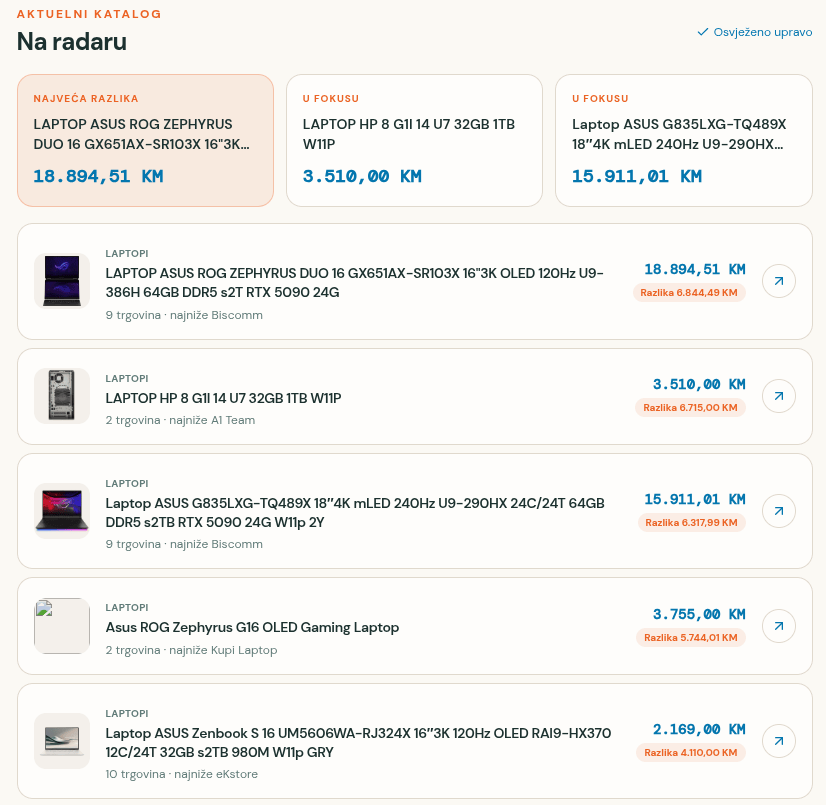
While traditional price comparison requires users to search for specific products, Product Radar takes a different approach.
It helps users discover relevant products and offers based on their individual interests.
Rather than repeatedly searching through different categories, users can configure a personal radar by selecting:
- Up to three favorite brands they want to follow.
- Up to three product categories, such as laptops, smartphones, televisions, gaming equipment, or smartwatches.
Based on these preferences, Product Radar displays matching products from Škrtica’s continuously updated catalog.
The feature goes beyond simple filtering.
Product Radar highlights:
- Largest Price Differences: Products with particularly large differences between retailer offers.
- Products in Focus: Relevant products matching the user’s selected interests.
- Retailer Comparisons: Information about how many stores offer a product and which retailer currently lists the lowest price.
- Potential Savings Opportunities: Visible price differences that may help users identify interesting offers.
For example, someone interested in laptops, smartphones, and televisions can configure Product Radar once and explore relevant offers without manually repeating the same searches.
The selected preferences remain stored in the user’s browser, making it convenient to return to a personalized shopping experience.
An important aspect of Product Radar is that it operates on actual products from the platform’s catalog rather than randomly generated recommendations.
While Price Alarm focuses on products users already want, Product Radar helps them discover relevant products and shopping opportunities they might otherwise miss.
This feature reflects an important part of my vision for Škrtica:
Moving beyond traditional price comparison toward proactive, interest-based product discovery.
Explore Product Radar on Škrtica.ba
5. Pametna korpa — Smart Basket
Another feature is Pametna korpa (Smart Basket).
Users can add products they are interested in to a personal shopping basket and monitor their prices over time.
Unlike a conventional shopping cart, the primary purpose is not to complete a purchase directly on Škrtica.
Instead, Smart Basket helps users organize potential purchases and follow price developments.
For example, someone planning to purchase several household appliances can collect the desired products and monitor opportunities to save money.
The goal is to make shopping more organized and reduce the effort required to monitor multiple retailer websites.
6. Price History and Market Transparency
The lowest available price today is not necessarily the lowest price a product has recently reached.
That is why historical price information is an important part of the platform.
Where sufficient data is available, Škrtica provides insights into how prices have changed during the monitoring period.
This helps consumers distinguish between an attractive current price and one that may be relatively high compared with recent observations.
Price history also forms the foundation for features such as purchasing recommendations and price alerts.
The longer the platform collects reliable pricing information, the more useful these historical insights can become.
7. Best Deals and Savings Discovery
Škrtica also helps users discover products with notable price differences between retailers.
For products offered by multiple stores, comparing available prices can reveal meaningful differences.
However, the objective is not simply to display the largest possible savings figure.
A meaningful comparison requires confidence that offers actually refer to the same product and that price and availability information is sufficiently up to date.
This is closely connected to one of the platform’s biggest engineering challenges: accurate product matching.
8. Mobile-Friendly Shopping and App Installation
Škrtica is also designed for convenient use on mobile devices.
As a Progressive Web App (PWA), it can be added to a supported device’s home screen, providing easier access to product searches, price comparisons, and shopping assistance features.
This enables an app-like experience without requiring a traditional app-store installation.
Together, these features reflect the direction I want to take Škrtica:
From a website that compares prices to a platform that helps consumers decide what to buy, where to buy, and when to buy.
Behind the Technology: Combining Software Engineering, Machine Learning, and AI
Developing Škrtica requires considerably more than collecting product prices and displaying them on a website.
One of the most interesting challenges is transforming large amounts of heterogeneous product data into structured, comparable information.
Online retailers use different website structures, product names, categories, descriptions, and naming conventions.
Even when two retailers sell exactly the same product, their descriptions can differ substantially.
A useful price comparison system must recognize those differences, identify matching products, and organize offers correctly.
To address these challenges, I developed a hybrid approach combining rule-based systems, machine learning classifiers, custom Named Entity Recognition (NER) models, specialized Transformer models, and Mixture-of-Experts (MoE) architectures.
1. Automated Product Data Collection
The first step involves collecting product information from online retailers.
This includes product names, descriptions, prices, availability, categories, and other relevant attributes.
Because retailers structure their websites differently, the system must handle heterogeneous data sources and continuously changing product information.
Automated data processing pipelines transform the collected information into formats suitable for further analysis.
2. Intelligent Product Matching
One of the central technical challenges is determining whether products listed by different retailers represent the same item.
Consider a hypothetical example:
- Samsung Galaxy S25 Ultra 256GB Black
- Samsung S25 Ultra 256 GB Titanium Black
- Galaxy S25 Ultra 256GB — Samsung
Although the titles differ, they may refer to the same product.
A price comparison system must recognize these similarities without incorrectly combining different models, storage capacities, or product variants.
For product matching, Škrtica uses a combination of:
- Rule-based matching: Explicit rules and constraints for recognizing and validating product similarities.
- Machine learning classifiers: Models that help classify and distinguish products based on their attributes and descriptions.
- Custom Named Entity Recognition models: AI models for identifying relevant entities and attributes within product information.
This hybrid strategy is particularly important because product matching is not simply a text similarity problem.
Two descriptions can look similar while referring to different product variants.
Conversely, two very different descriptions may refer to the same physical product.
The objective is to improve matching quality while reducing incorrect product associations.
3. Intelligent Category Classification Using Transformers and Mixture of Experts
Another major technical challenge is product categorization.
Different retailers use completely different category structures, naming conventions, and levels of detail.
For example, the same product might appear under Electronics, Computers, Laptops, or a more specialized category depending on the retailer.
To address this problem, Škrtica combines traditional rule-based methods with specialized Transformer-based classification models and Mixture-of-Experts (MoE) architectures.
Transformer models are useful because they can learn contextual relationships within product titles and descriptions, going beyond simple keyword matching.
Instead of relying exclusively on predefined words, these models help interpret product descriptions and assign products to relevant categories.
The platform also incorporates a Mixture-of-Experts approach, where multiple specialized models contribute to classification decisions.
This is valuable because product categories can be highly diverse.
Classifying computer hardware, household appliances, cosmetics, and automotive components may require different types of knowledge and classification patterns.
Combining specialized models with deterministic rules and extracted product attributes provides a more flexible approach than relying on a single classification method.
4. Custom AI Models for Named Entity Recognition
Another important component of Škrtica is the use of custom AI models for Named Entity Recognition (NER).
NER is a Natural Language Processing technique used to identify and extract meaningful entities from text.
In product catalogs, relevant entities can include brands, product models, technical specifications, and other distinguishing attributes.
For example, a product description may contain information about a manufacturer, model family, storage capacity, or device variant.
Extracting these entities can help distinguish between products that are superficially similar but technically different.
My experience with NLP, machine learning, and cybersecurity information extraction has been particularly valuable in approaching this problem.
Although the application domain is different, many underlying challenges resemble those encountered in Cyber Threat Intelligence processing: extracting structured knowledge from unstructured text, classifying information, and identifying meaningful relationships.
5. The Challenge of Accuracy at Scale: Even 1% Matters
One lesson from developing Škrtica is that achieving high classification accuracy is not the same as achieving perfect data quality.
Even sophisticated AI models make mistakes.
Product descriptions can be incomplete, inconsistent, ambiguous, or incorrect.
A classification model may assign a product to the wrong category. A matching system may incorrectly associate two similar products.
Alternatively, the system may fail to recognize that two differently described offers refer to the same product.
With a catalog containing more than 550,000 products, even seemingly small error rates become significant.
Consider a hypothetical classification accuracy of 99%.
That would still leave approximately 5,500 incorrectly classified products, assuming a 1% error rate across 550,000 products.
And this example concerns classification alone.
Product matching introduces additional challenges because incorrect associations can affect which prices are compared.
The larger the product catalog becomes, the more important quality assurance becomes.
This is why Škrtica combines multiple approaches rather than relying exclusively on a single AI model.
Rule-based validation, machine learning, Transformer models, NER-based attribute extraction, and specialized classification components each contribute to addressing different aspects of the problem.
Nevertheless, no approach completely eliminates incorrect results.
Improving product matching and categorization is therefore an ongoing engineering process involving model evaluation, data validation, error analysis, and continuous refinement.
For a consumer platform, even a small percentage of incorrect results matters because users depend on the accuracy of the information when making purchasing decisions.
Building a reliable platform is not just about increasing the number of products. It is equally about improving the quality and consistency of the information.
6. Backend Architecture: Node.js and Python
Škrtica’s backend is built using Node.js and Python.
This combination supports both general application development and data-intensive processing.
Node.js provides a foundation for backend application services, while Python supports the implementation of data processing, machine learning, and AI-related functionality.
Together, these technologies form the technical foundation of the platform.
7. Frontend Architecture: React
The frontend is developed using React, providing the interface through which consumers interact with the platform.
A major design goal has been to make complex data processing appear simple to the end user.
Regardless of how much work takes place behind the scenes, consumers should be able to search for products, compare prices, track offers, and use shopping assistance features with minimal effort.
For me, that represents one of the most important principles of software engineering:
The complexity should remain in the system, not in the user experience.
How My AI Research Background Influenced Škrtica
My professional work at the AIT Austrian Institute of Technology and doctoral research at TU Wien focus on artificial intelligence, large language models, natural language processing, information retrieval, and cybersecurity.
Although Škrtica is my independent entrepreneurial project, my research background has strongly influenced its technical development.
In my scientific work, I investigate methods for processing, classifying, retrieving, and interpreting complex information.
Many of these concepts are directly relevant to building intelligent product matching and categorization systems.
The use of custom NER models, Transformer-based classification, Mixture-of-Experts architectures, and carefully designed rule-based approaches reflects my belief that effective intelligent systems often benefit from combining multiple techniques.
Not every problem requires a large language model.
Sometimes deterministic rules provide the most reliable solution. In other situations, machine learning and specialized neural models help address ambiguity that cannot easily be captured by explicit rules.
The challenge is knowing how to combine these methods effectively and evaluate their performance.
My goal is not to introduce AI simply because it is fashionable, but to apply it where it creates genuine value.
The First Results: Over 550,000 Products and 770,000 Offers
The initial growth of Škrtica has been encouraging.
By late October 2026, the platform had reached several important milestones:
- More than 550,000 products available for discovery and comparison.
- More than 770,000 product offers collected from online retailers.
- Hundreds of online stores represented on the platform.
- More than 50,000 page views within five days of its public announcement.
The product catalog and number of offers continue to grow as new information is collected and processed.
Reaching more than 50,000 page views during the first five days was particularly encouraging.
These figures represent page views rather than 50,000 unique visitors, but they nevertheless demonstrated early public interest in the concept.
Of course, initial visibility is only one indicator of progress.
Long-term success will depend on data quality, platform reliability, recurring usage, and whether consumers genuinely benefit from the service.
The Moment That Surprised Me: Over 6 Million KM in Price Differences
One of the most remarkable moments during the development of Škrtica happened before the platform was publicly launched.
While testing an early demo, I was exploring the product catalog and examining the price differences between retailers.
I wanted to understand how much prices varied across comparable products and what those differences could tell us about the value of price transparency.
During one of these tests, I calculated the aggregate price differences across the indexed products for a single day’s snapshot.
The result genuinely surprised me: more than 6 million KM in observed price differences.
And that was just one day.
To put this into perspective, the figure represented the combined differences in listed prices across comparable products in the platform’s catalog at that point in time.
It did not mean that consumers had already saved 6 million KM, nor that this amount could automatically be realized as savings.
Rather, it demonstrated the enormous amount of pricing information that remains scattered across different online retailers.
Consider a simple example.
If the same product is offered by one retailer for 900 KM and another for 1,050 KM, there is a difference of 150 KM.
For an individual consumer, discovering that difference before purchasing could be valuable.
Now consider what happens when similar price differences are identified across thousands of products and hundreds of retailers.
The cumulative amount can become surprisingly large.
Of course, meaningful comparisons depend on accurate product matching, availability, and current price information.
But seeing more than 6 million KM in aggregated price differences during a single pre-launch analysis was a defining moment for me.
It reinforced my belief that the real value of Škrtica is not simply having a large product database, but making otherwise fragmented market information accessible and understandable.
What began as an idea inspired by comparing computer components in Austria had become a platform capable of revealing substantial price differences in the Bosnian online retail market.
And that happened before Škrtica had even been officially introduced to the public.
Why Price Comparison Matters
One of the motivations behind Škrtica was the observation that identical products can have significantly different prices across retailers.
For example, during an early comparison, a DeLonghi DCH7993ER.BC ceramic heater was listed at prices ranging from 230.95 KM to 339.66 KM.
That represents a difference of 108.71 KM.
Such examples demonstrate why comparing offers before purchasing can be worthwhile.
Naturally, prices and availability change over time, and historical price differences do not guarantee current savings.
However, the broader principle remains:
Consumers should have convenient access to information that helps them make better purchasing decisions.
Media Attention and the First Public Reactions
The public launch of Škrtica generated encouraging media interest in Bosnia and Herzegovina.
The platform was covered by several media outlets, including:
I also had the opportunity to present the platform in a television interview and discuss the motivation behind developing a practical technology product for the Bosnian market.
Watch the Television Interview About Škrtica.ba
Seeing an idea that had existed for so many years become a functioning platform — and then attract public attention — has been a rewarding experience.
But media visibility is only the beginning.
Building a sustainable technology product requires continuous improvement, long-term commitment, and the ability to deliver real value.
What’s Next for Škrtica.ba?
Launching the platform was only the beginning.
My current development priorities include:
- Expanding retailer and product coverage.
- Improving AI-assisted product matching and categorization.
- Refining Transformer-based classification and Mixture-of-Experts models.
- Further developing custom machine learning and NER models.
- Reducing classification errors and incorrect product associations.
- Improving Price Alarm, Product Radar, and Smart Basket functionality.
- Strengthening price history, purchasing recommendations, and data quality.
- Improving search performance and product discovery.
- Making the overall shopping experience simpler, faster, and more reliable.
My long-term vision is to develop Škrtica into a reliable and increasingly intelligent shopping platform.
I believe there is considerable potential for technology-driven solutions that address practical challenges in Bosnia and Herzegovina.
Škrtica is my contribution to making online shopping more transparent, convenient, and accessible.
For now, my priority is straightforward:
Build a reliable product, listen to users, improve continuously, and create genuine value.
Fourteen Years Later: From an Idea to a Real Product
Looking back, it is interesting how different experiences eventually came together.
Using Geizhals.at to compare computer components during my student years.
Working as a software architect on a hotel-offer platform connected to Trivago.
Studying computer science at TU Wien.
Building a career in software engineering, artificial intelligence, and scientific research.
Developing custom machine learning and NLP solutions.
And eventually finding a name inspired by both an Austrian price comparison website and a family nickname.
All of these experiences contributed in different ways to the creation of Škrtica.
The platform is still at an early stage, with many challenges and opportunities ahead.
But seeing an idea that stayed with me for approximately 14 years finally become a functioning product is already an important personal milestone.
For me, Škrtica represents something beyond price comparison: the connection between curiosity, scientific thinking, artificial intelligence, software engineering, and entrepreneurship.
Sometimes the most interesting projects begin with something as simple as comparing prices for computer components.
And sometimes, the perfect name is already part of your everyday life.
Explore the platform: Škrtica.ba — Compare Prices in Bosnia and Herzegovina
Dženan Hamzić is an AI and cybersecurity scientist at the AIT Austrian Institute of Technology, a PhD researcher at TU Wien, and the founder of Škrtica.ba.
Keep Growing!


Leave a Reply